When hotel owners and marketing directors first realize that guests are using ChatGPT, Google Gemini, and Perplexity to book stays, their first instinct is natural: “Can’t we just check our rankings in Semrush or Ahrefs?”
Or perhaps: “Can’t we just open ChatGPT, type ‘best hotel in our city’, and see if we show up?”
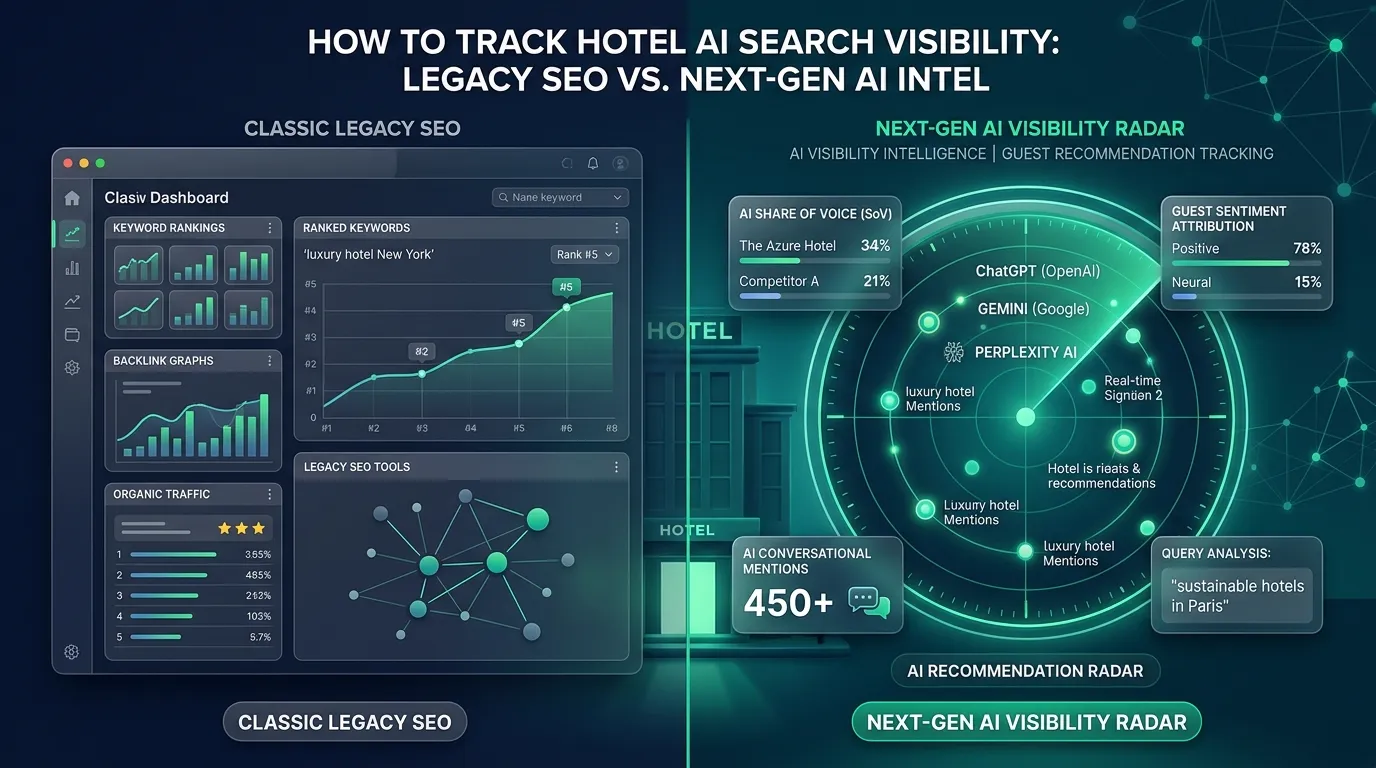
Unfortunately, tracking visibility in generative AI search is fundamentally different from tracking traditional search engines. What worked for twenty years in digital marketing (rank trackers, keyword density counters, and backlink checkers) completely breaks down when faced with conversational neural networks.
In this guide, we explore why tracking hotel AI visibility is virtually impossible without specialized tools, evaluate how existing solutions like Semrush, Ahrefs, and HotelRank attempt to address this challenge, and explain how a dedicated hospitality platform like Signalia.ai operates under the hood.
Why You Can't Just 'Google Yourself' on ChatGPT
Before looking at software tools, let's understand why manual testing fails. When hoteliers test ChatGPT from their laptop, they encounter three invisible traps:
1. The Personalization & Cache Trap
Your browser and OpenAI account carry memory, browsing history, and localized GPS coordinates. If you ask ChatGPT about your own hotel, it may cite your property simply because it knows your location or previous queries. A traveler querying from New York, Berlin, or London will receive an entirely different synthesis.
2. The Non-Deterministic Nature of LLMs
Large Language Models are probabilistic, not static databases. Run the exact same prompt ten times, and the wording will adjust. Single-prompt manual checks give you zero statistical confidence. To understand true market visibility, you need to execute hundreds of standardized iterations across multiple temperature settings and seed states.
3. The Infinite Query Permutation Problem
Guests do not ask: “Hotels in Barcelona”. They ask: “Boutique hotels in Gothic Quarter with fast Wi-Fi for remote work, king beds with quiet courtyard rooms, and specialty breakfast for under €250/night.” You cannot manually test 500 permutations of traveler personas every morning.
How Existing Tools Attempt to Measure AI (And Where They Fall Short)
Hotels already pay for several categories of software. Let's look honestly at how they handle generative AI visibility:
| Tool Category | Key Tools | What They Track | The Critical Blind Spot for Hotels |
|---|---|---|---|
| General SEO Suites | Semrush, Ahrefs | AI Overviews, brand citations in search snippets, website domain keywords, and backlink graphs | They track general web queries, not hotel-specific intent. To configure tracking filters and interpret the data, users need substantial technical SEO expertise. Furthermore, they have zero connection to guest reviews or hospitality operations. |
| Local Rank Trackers | HotelRank, BrightLocal | Google Maps geo-grid rankings (Local 3-Pack placement) | Limited strictly to Google Maps distance grids. They don't test conversational prompts or synthesize why an AI recommends a competitor. |
| Specialized AI Platform | Signalia.ai | Multi-model AI Share of Voice (ChatGPT, Gemini, Perplexity), persona clusters, and sentiment root-cause attribution | Purpose-built specifically for hotels; requires zero SEO jargon or technical training; directly connects public guest reviews to AI recommendation outcomes. |
1. Semrush & Ahrefs: Powerful for General SEO, But Not Built for Hotels
Both Semrush and Ahrefs are premier digital marketing suites. Both platforms have recently introduced features to monitor AI visibility (such as tracking brand presence in Google AI Overviews and Brand Monitoring across generative search snippets).
However, when a hotel tries to use Semrush or Ahrefs for tracking AI visibility, they quickly hit two major roadblocks:
You Need Serious SEO Knowledge to Set It Up: Semrush and Ahrefs are built for professional SEO agencies, not busy hotel General Managers or Front Office teams. Configuring keyword clusters, setting up regex query filters, sorting through SERP features, and distinguishing between domain-level citations and brand mentions requires technical search expertise. Without an in-house SEO specialist, hotel teams get lost in complex graphs.
They Are Not Specific to Hospitality: Semrush and Ahrefs treat a hotel exactly like an e-commerce store, a SaaS company, or a law firm. If ChatGPT recommends your hotel because a verified Booking.com review praised your soundproofed courtyard rooms, Semrush reports zero visibility because your direct website domain was not linked as the citation source.
Zero Review Sentiment Grounding: Even when an SEO suite flags a brand mention, it cannot analyze your guest feedback across Google, TripAdvisor, and Booking.com to tell you why an AI model omitted your property.
2. HotelRank & Geo-Grid Trackers: Built for Google Maps Proximity
Tools like HotelRank focus on the Google Local Pack. They place a virtual pin over your city and check where your hotel ranks on Google Maps every 500 meters.
This is valuable for someone walking down the street searching “coffee near me”. But generative AI travel assistants don’t care about geometric geo-grids. A traveler asking for “a romantic boutique hotel in Rome with quiet rooms” wants quality and vibe, not whatever building happens to be closest to the train station. Geo-grid tools cannot measure conversational intent or cross-engine share of voice.
The 4 Technological Capabilities Required to Track AI Visibility Accurately
Why does tracking AI visibility require a specialized architecture? Because to do it properly, an engine must handle four non-trivial data pipelines simultaneously:
1. Continuous Multi-Model Synthetic Probing
The system must maintain headless API connectors across all four frontier model families: OpenAI (GPT-4o / SearchGPT), Google (Gemini 1.5 Pro / AI Overviews), Perplexity, and Anthropic Claude. Each model requires normalized prompt wrappers that simulate authentic, non-cached traveler inquiries.
2. Semantic Entity Resolution
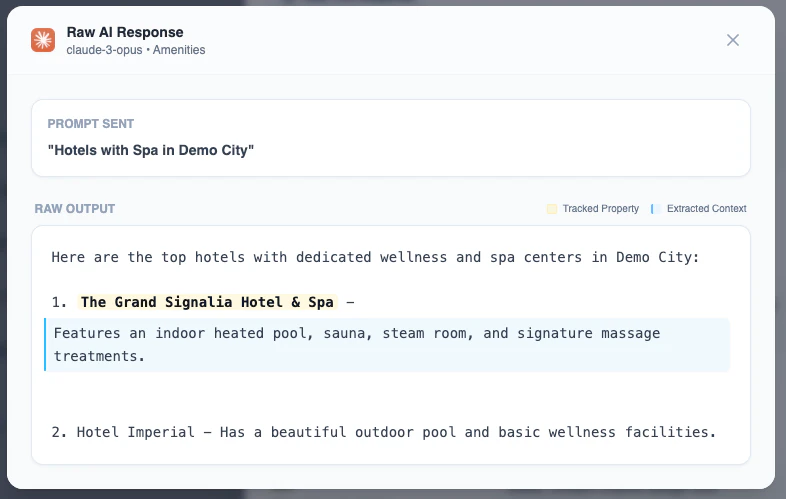
In traditional search, an algorithm matches a domain string like hotel-astoria-paris.com. In conversational AI, the model might say “Astoria Palace”, “The historic Astoria on Rue de Lafayette”, or “Hotel Astoria & Spa”. A specialized engine must resolve natural-language text into a verified hotel entity and calculate its exact recommendation rank (#1 Top Pick vs #3 Alternate).
3. Intent Cluster Win Rate Matrix
Instead of tracking 5 static keywords, the system must organize queries into distinct traveler occasions:
Occasion Clusters
Couples / Honeymoon, Business Executive, Family Stays, Solo Remote Work.
Feature & Sensory Clusters
Soundproofed sleep, artisanal breakfast, historic charm, underground EV parking.
This allows hotels to see where they are winning high-intent bookers and where they are invisible.
4. The Missing Link: Aspect-Level Review Attribution
This is where general tools fail completely. AI search engines do not decide who to recommend in a vacuum. As shown in our Silent Night Penalty Report, LLMs crawl public guest reviews across Google Maps, Booking.com, and TripAdvisor. If multiple reviews mention rattling air conditioning, conversational engines will actively advise travelers to avoid your property.
A specialized tool must connect what AI says about you directly to what guests wrote about you last week.
How Signalia.ai Bridges the Gap
Signalia was engineered specifically to solve this problem for hospitality operators and asset managers. Rather than retrofitting an old keyword tool, Signalia unifies two essential halves of modern discovery:
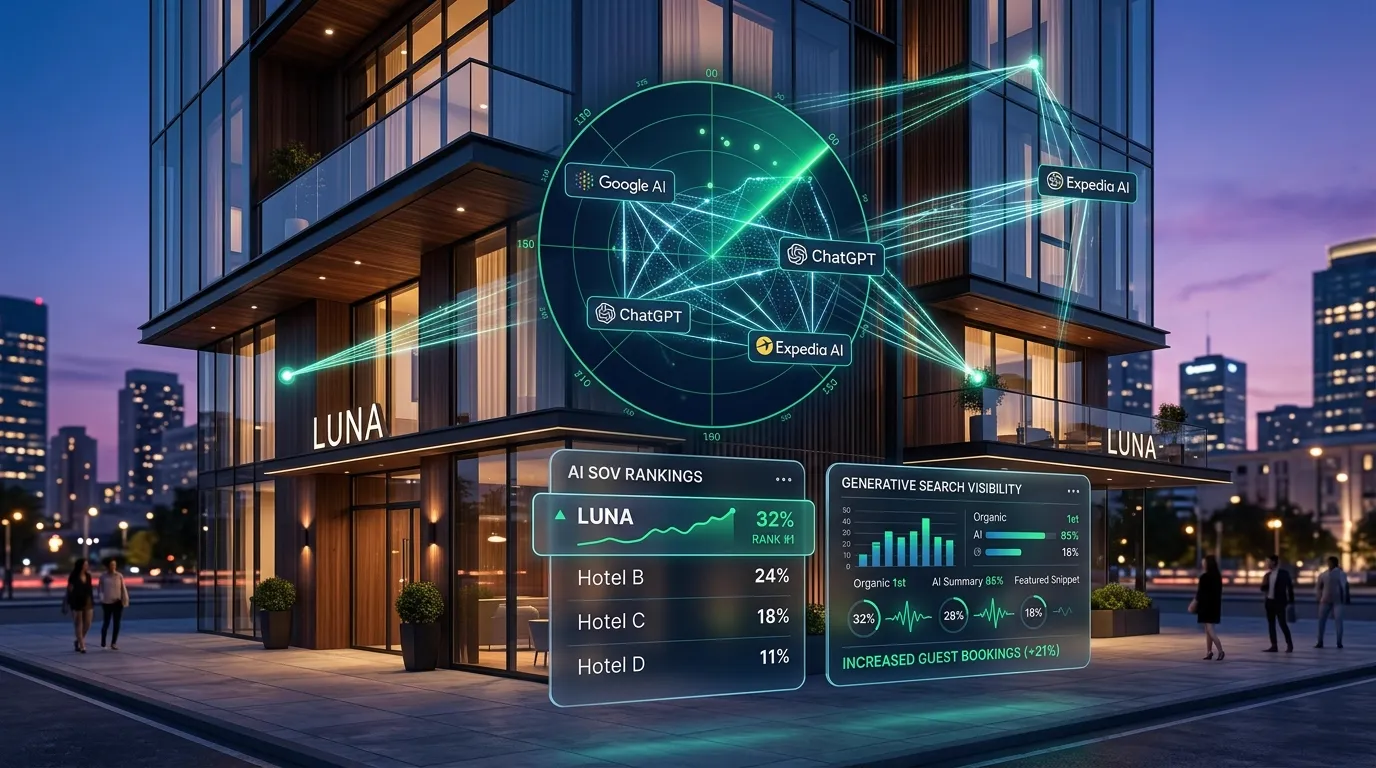
The AI Visibility Radar: Continuously monitors Share of Voice, Recommendation Rank, and Model Consensus across ChatGPT, Gemini, and Perplexity (explore our AI Visibility Platform).
Reputation Intelligence: Ingests guest reviews across all major channels, deconstructs compound sentences into 48 operational departments, and shows hoteliers the exact review complaints that are suppressing their AI recommendations (learn more in our Hotel Reputation Intelligence Platform).
The Operational Difference: When Semrush reports a keyword drop, you can only change a blog post title. When Signalia reports a drop in AI Share of Voice, it tells you: “ChatGPT is omitting you from quiet weekend queries because 4 recent reviews cited hallway door slamming. Fix the hydraulic door closers on the 3rd floor to recover your AI recommendation rank.”
Summary: The Right Tool for the Generative Era
As traveler discovery moves from search boxes to conversational assistants, hotels cannot rely on tools designed for the ten-blue-link era. While Semrush and Ahrefs can track AI Overviews for websites, they require specialized SEO knowledge and lack hospitality context. Meanwhile, HotelRank focuses on map proximity grids. For understanding and capturing hotel bookings from conversational AI, specialized hospitality intelligence is indispensable.
🚀 Want to see where your hotel stands in AI search today?
Claim your complimentary multi-model assessment across ChatGPT, Google Gemini, and Perplexity: 👉 Request Your Free Hotel AI Visibility Audit or explore our empirical Zagreb Hotel AI Benchmark.