In modern hotels, numbers drive decisions. General Managers track revenue metrics like RevPAR and GOPPAR every week. Yet when measuring guest happiness, many hotels still rely on outdated, sluggish scores.
For years, hotel leaders tracked three familiar letters: GRI, NPS, or OSAT.
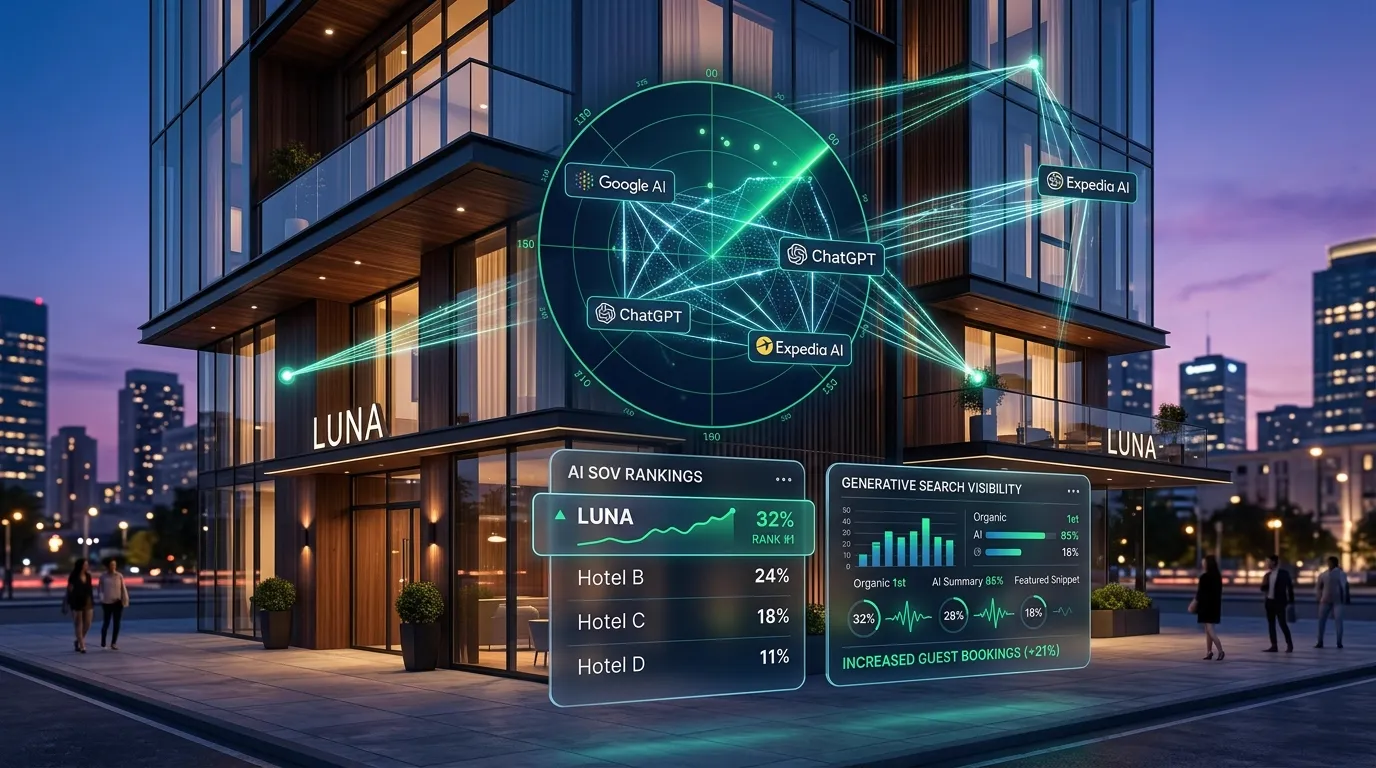
But travel has changed. Over 40% of travelers now use AI search (like ChatGPT, Gemini, and Google) to find hotels. Static scores from six months ago no longer reflect how AI models or guests see your property today.
That is why top hotels now measure Hotel RPS (Review Performance Score).
In this guide, you will learn:
- What the Hotel RPS metric is and how it works.
- How RPS compares to traditional scores like GRI, NPS, and OSAT.
- Five key rules to calculate hotel performance accurately.
- How RPS drives higher direct bookings and AI search recommendations.
The 4-Pillar Hospitality Metric Framework
To understand why RPS matters, let's look at the four main metrics hotels use today:
| Metric | Core Focus & Role | Data Source | Typical Frequency | Primary Limitation |
|---|---|---|---|---|
| GRI (Global Review Index™) | Reputation Benchmark Long-term benchmark across portfolios and competitor sets | Public OTA and review sites | Monthly, quarterly, or yearly | Lagging indicator. It reacts very slowly to recent changes. |
| NPS (Net Promoter Score) | Loyalty & Advocacy Private guest loyalty and referral intent | Private email and SMS surveys | Sent after checkout | Very low response rates (<5%). Invisible to future bookers. |
| OSAT (Overall Satisfaction) | Overall Sentiment Single snapshot score (e.g. 8.4/10 or 4.2/5) | Booking.com, Google, TripAdvisor | Cumulative average | Vague score. It does not explain why guests were unhappy. |
| RPS (Review Performance Score) | Performance Accountability Live operational health combining recency, department sentiment & reply speed | Live public reviews + response speed logs | Real-time 30-day rolling window | Requires live review streaming and topic sentiment analysis. |
The Key Difference: While GRI looks backward at annual trends, NPS measures private survey intent, and OSAT gives a simple average, RPS is the real-time heartbeat of your hotel. It tells managers: How well did each department perform over the last 30 days?

Why Legacy Metrics Leave Blind Spots for Hotel Operations
Relying only on traditional metrics creates three major blind spots for hotel managers:
1. The GRI Lagging Trap (Delayed Benchmarks)
The Global Review Index™ is great for asset owners comparing properties over 12 to 24 months. But it changes very slowly.
- Why it fails daily operations: An air conditioning failure during a heatwave barely moves your GRI needle right away.
- The problem: If your new housekeeping team fixes cleanliness standards this week, GRI will not show that success for months.
2. The NPS Survey Bias Problem
Net Promoter Score relies on surveys emailed after checkout. But post-stay surveys have two huge flaws:
- Almost no one fills them out: Fewer than 5% of guests complete email surveys. Only ecstatic VIPs or furious guests bother to respond.
- The data is hidden: NPS results stay locked inside your private CRM. Prospective guests on Google or Booking.com never see your score.
3. The OSAT Ambiguity (No Explanations)
An overall score like 8.4/10 or 4.2/5 shows what guests felt, but never why.
- Did ratings drop because of slow check-ins?
- Were eggs cold at breakfast?
- Was street noise keeping guests awake?
- Did negative reviews sit without replies?
A simple star average gives managers zero clues on what to fix first.
What is Hotel RPS (Review Performance Score)?
Hotel RPS (Review Performance Score) is an operational metric that tracks your hotel's daily service quality and guest satisfaction.
Unlike multi-year averages, RPS focuses on what is happening right now. It combines recent guest reviews across all major travel channels, breaks down feedback by department, and checks how fast your team replies to negative reviews.
What is Important to Calculate Hotel Performance Accurately?
Building a reliable performance score takes more than adding up star ratings. An accurate system must follow five core principles:
1. Prioritizing Recency over Ancient Praise
In hospitality, yesterday's guest experience matters much more than what happened eight months ago.
- A 5-star review from last summer will not help if service slipped last weekend.
- RPS weights recent reviews much higher so managers see the immediate impact of operational changes.
2. Granular Departmental Attribution
Overall averages hide where the real fires are. An effective score separates feedback into distinct operational departments:
- Housekeeping & Cleanliness: Room turnover, linen hygiene, and bathroom cleanliness.
- Food & Beverage: Breakfast quality, food temperature, buffet refills, and dining service.
- Front Desk & Reception: Arrival warmth, check-in speed, and front desk problem resolution.
- Room Comfort & Sleep: Mattress comfort, noise insulation, soundproofing, and AC control.
- Facilities & Value: Wi-Fi reliability, amenities, and overall value for money.
When each department has its own score, managers can praise top performers and fix bottlenecks without guesswork.
3. Cross-Platform Normalization
A 4.5 on Google Maps is not the same as an 8.8 on Booking.com or a 4.0 on TripAdvisor.
Each platform uses different rating scales and attracts different traveler types. A reliable metric normalizes these scores onto one unified 0–100 scale without distorting guest sentiment.
4. Active Guest Engagement and Response Health
Online reviews are a two-way conversation. How quickly and genuinely a hotel responds shows its operational culture.
- RPS measures response turnaround time and coverage on critical negative reviews.
- It rewards personalized, helpful answers over generic copy-pasted templates.
5. Statistical Volume & Noise Protection
One unfair 1-star review should not destroy your reputation score. Nor should a few reviews from friends artificially boost it.
A fair scoring system accounts for review volume and sample size. This gives hotels of all sizes a balanced, dependable score.
How RPS Powers AI Visibility & Direct Bookings
Travel planning has changed forever. Over 40% of travelers now use AI assistants like ChatGPT, Gemini, Apple Intelligence, and Perplexity to choose accommodations.
When a traveler asks an AI:
The AI does not read private surveys. It scans live public reviews, recent ratings, and owner responses.
🎯 Three Ways High RPS Drives Hotel Revenue
Research proves that strong, fresh review scores directly boost revenue:
- Cornell University Study: A 1-point increase on a 5-point scale (or a 10-point lift in RPS) lets a hotel raise room rates by up to 11.2% without losing occupancy.
- AI Search Recommendations: AI engines favor hotels with fresh reviews, high recent sentiment, and active replies, recommending them over competitors with outdated feedback.
- Higher Direct Bookings: When travelers see thoughtful, authentic replies to negative feedback, direct website bookings jump by 18% to 24%.
Step-by-Step: How a General Manager Uses RPS Every Morning
Here is how a General Manager uses the Hotel RPS metric in a 5-minute morning check:
08:30 AM — Check the 30-Day RPS Gauge:
Open the dashboard. A steady upward trend confirms strong operational health across all shifts.08:32 AM — Inspect Department Dials:
Look at individual scores. Housekeeping and Front Desk are green, but Breakfast dipped slightly over the weekend.08:33 AM — Review AI Root-Cause Themes:
Click into the breakfast score. Recent guest comments mention “coffee machine queue during the 9:00 AM rush” and “empty pastry trays”.08:34 AM — Assign an Instant Fix:
At the morning briefing, the GM asks the restaurant supervisor to set up a second coffee station during peak hours.08:35 AM — Approve AI Reply Drafts:
Approve tailored AI reply drafts in seconds. The replies thank guests, apologize for the rush, and announce the second coffee station.
Comparing Hotel Metrics: Which Metric Should You Use?
Modern hotels do not have to choose just one score. Each metric serves a distinct purpose:
Use GRI for quarterly board meetings, investor updates, and multi-year competitor benchmarking.
Use NPS for private guest loyalty programs, VIP follow-ups, and email marketing lists.
Use OSAT for a quick, high-level snapshot on individual OTA channels.
Use RPS as your daily operational dashboard for team accountability, department bonuses, review replies, and AI search visibility.
RPS in the Reputation Intelligence Cluster: Connecting Feedback to Revenue
Hotel RPS is the quantitative engine behind modern Hotel Reputation Management and Hotel Reputation Intelligence.
Rather than leaving reviews in a passive inbox, modern reputation intelligence links guest sentiment directly to daily action in five steps:
Stream All Reviews: Bring in guest feedback from Google, Booking.com, and TripAdvisor into one place.
Uncover Topic Trends: Use NLP to spot specific issues across Housekeeping, Breakfast, and Front Desk (see our AI Review Analysis).
Track the Live RPS Scorecard: Turn thousands of guest reviews into a clear 0–100 performance score for each department.
Reply Fast in Your Hotel Voice: Draft personalized replies in 30+ languages in seconds (see our AI Review Replies Tool).
Win AI Search Recommendations: High recent review scores help AI assistants recommend your hotel first to travelers.
To learn more about modern reputation platforms, read our complete guide on What is Hotel Review Software and Reputation Intelligence?.
Summary: Performance Accountability is the New Competitive Advantage
In hospitality, you cannot manage what you do not measure accurately. Outdated, yearly review averages belong to the past.
With Hotel RPS (Review Performance Score), independent and boutique hotels turn everyday guest reviews into a clear action plan—improving operations, winning guest trust, and driving higher direct revenue.
🚀 Want to see your hotel's live RPS score?
Get an instant breakdown of your property's review performance, department scores, and reply speed: 👉 Request Your Free Reputation Health Check or try our Free AI Review Reply Tool.