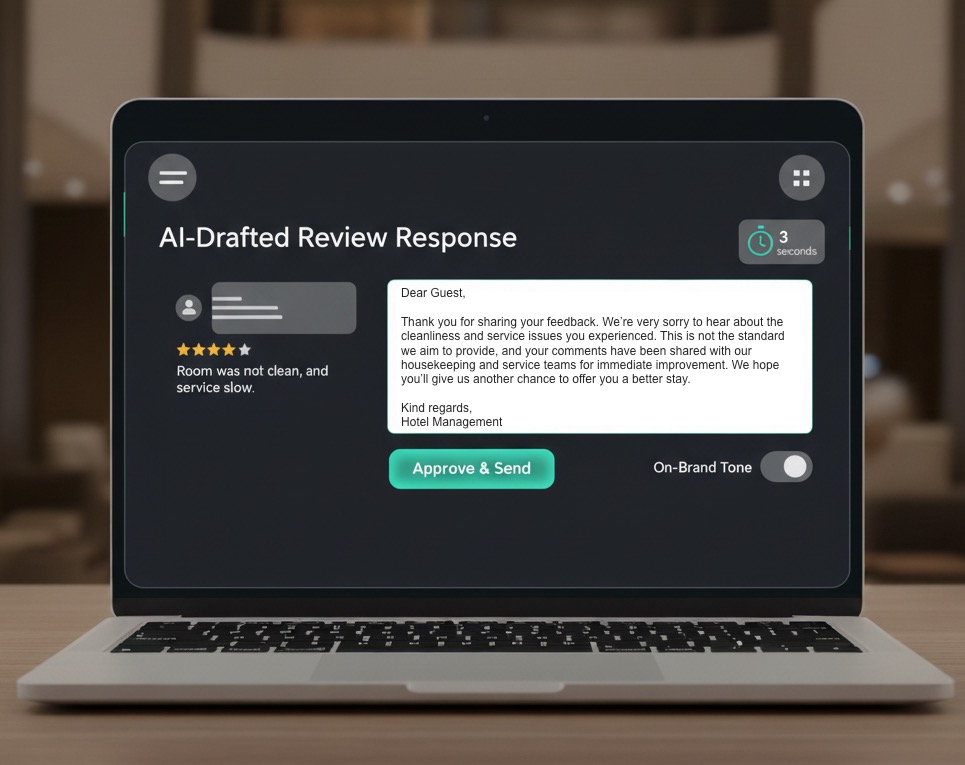
Today, we’ll explore how to design a “Review Response Chatbot” that writes like a human, feels like management, and earns genuine trust.
Tone & Empathy: The Human Touch in Every Response
The first rule of online review management? Empathy beats automation. Even when a chatbot is doing the writing, it should sound like a person who cares : not a script.
Key Principles
Always thank the reviewer first.
Acknowledge their emotions, not just their words.
Avoid empty phrases like “we regret the inconvenience.” Instead, say:
“We’re truly sorry you experienced this during your stay.”
Write in the voice of leadership : not like a clerk or call center agent.
Chatbot Logic:
If the review rating is 2 stars or lower → start with deep empathy and personalization.
If it’s a positive review → lead with gratitude and reinforce brand strengths.
Structure of a Perfect Review Response
A well-crafted response follows a reliable, human-centered structure:
Thank them – “Thank you for sharing your feedback.”
Acknowledge concerns – Validate their experience.
Show action – Mention reviews, inspections, or fixes in progress.
Look ahead – Explain how future guests will benefit from improvements.
Invite connection – Offer to discuss privately.
Close warmly – End with gratitude and commitment to improvement.
Chatbot Logic:
Break reviews into themes (cleanliness, service, amenities).
Match each theme with a personalized acknowledgment and corrective note.
Handling Negative Reviews (1–2 Stars)
Negative reviews are emotional moments : and the right response can turn critics into advocates.
Best Practices
Don’t rush, but don’t delay : unanswered bad reviews signal indifference.
Avoid copy-paste templates; authenticity shows in detail.
Specificity builds credibility:
“We’ve repaired the fitness equipment” is far stronger than “We’ll look into it.”
Always invite private dialogue to resolve the issue.
Chatbot Logic:
Detect very negative tone → prioritize empathy and a direct human invitation.
If multiple complaints → reply to each one, briefly but clearly.
Handling Positive Reviews (4–5 Stars)
Positive feedback is your opportunity to reinforce loyalty and show pride in your team.
Best Practices
Be gracious and personal.
Echo back what they loved : “We’ll share your compliments with our housekeeping team.”
Reinforce brand strengths subtly.
Encourage their return: “We can’t wait to welcome you back!”
Chatbot Logic:
Detect themes (staff, cleanliness, comfort).
Mirror their praise using brand-aligned tone and optional marketing touchpoints.
Philosophy Behind the Bot: More Than Reputation Management
A truly effective chatbot doesn’t just defend your reputation : it helps you learn and improve.
Reviews are operational feedback, not just marketing.
Internal action matters more than external apology : but guests judge care by what you say publicly.
Encourage a company culture where employees can fix issues proactively, not fear punishment.
Highlight prevention: show guests how their feedback led to better experiences.
Remember: 5-star delight drives repeat business : aim for more than damage control.
Risks to Avoid
Even the smartest chatbot can go wrong without clear boundaries:
❌ Don’t rely on overused templates.
❌ Don’t invent fixes or details that aren’t true.
❌ Don’t sound defensive (“but at least…”).
✅ Know when to escalate to a human : especially for sensitive or legal issues.
Smart Capabilities to Build In
To make your review-response chatbot truly powerful:
Sentiment detection → identify positive, neutral, or negative tone.
Entity extraction → detect themes (cleanliness, service, value).
Response variation → use multiple templates for the same tone to avoid robotic replies.
Escalation triggers → send serious complaints to a manager.
Knowledge injection → include verified facts about amenities or policies.
Chatbot Playbook in Action
Step 1: Detect Sentiment
| Review Type | Tone Strategy |
|---|---|
| ⭐⭐⭐⭐–⭐⭐⭐⭐⭐ | Gratitude + Reinforcement + Loyalty |
| ⭐⭐⭐ | Appreciation + Acknowledge + Reassure |
| ⭐⭐–⭐ | Empathy + Specific Acknowledgment + Action + Contact |
Step 2: Extract Entities
Detect and classify key topics:
Cleanliness: room, bathroom, odor, housekeeping
Service: staff, reception, management
Amenities: pool, WiFi, breakfast
Value: pricing, worth, extras
Noise/comfort: bed, AC, location
Step 3: Use Response Skeletons
🟢 Positive Review Example
Thank you, [Name], for your wonderful review!
We’re delighted you enjoyed [specific element, e.g., our friendly staff or spotless rooms].
Your kind words mean a lot to our team, and I’ll be sure to share your feedback with them.
We look forward to welcoming you back soon for another memorable stay
🟡 Mixed Review Example
Thank you for taking the time to share your feedback, [Name].
I’m glad to hear you appreciated [positive mention], but I’m concerned about [specific issue].
We’ve already [real action if applicable, e.g., scheduled maintenance].
Your input helps us improve, and we hope to provide a smoother experience next time
🔴 Negative Review Example
Dear [Name],
I’m truly sorry to read about your experience with [specific issue].
This falls short of the standards we hold ourselves to, and I take your concerns seriously.

We’ve reviewed the matter with [relevant team], and corrective steps are underway.
I’d appreciate the chance to speak with you personally :  I’ve sent a private message with my contact details.

Thank you for bringing this to our attention.
Sincerely,
[Manager’s Name]
Final Takeaway
A review response chatbot isn’t about faking empathy : it’s about scaling genuine hospitality.
The best bots mirror what great managers already do: listen, empathize, act, and care.
When your automated responses sound like leadership speaking with heart : not PR writing damage control : you’ll earn more than stars. You’ll earn trust.